

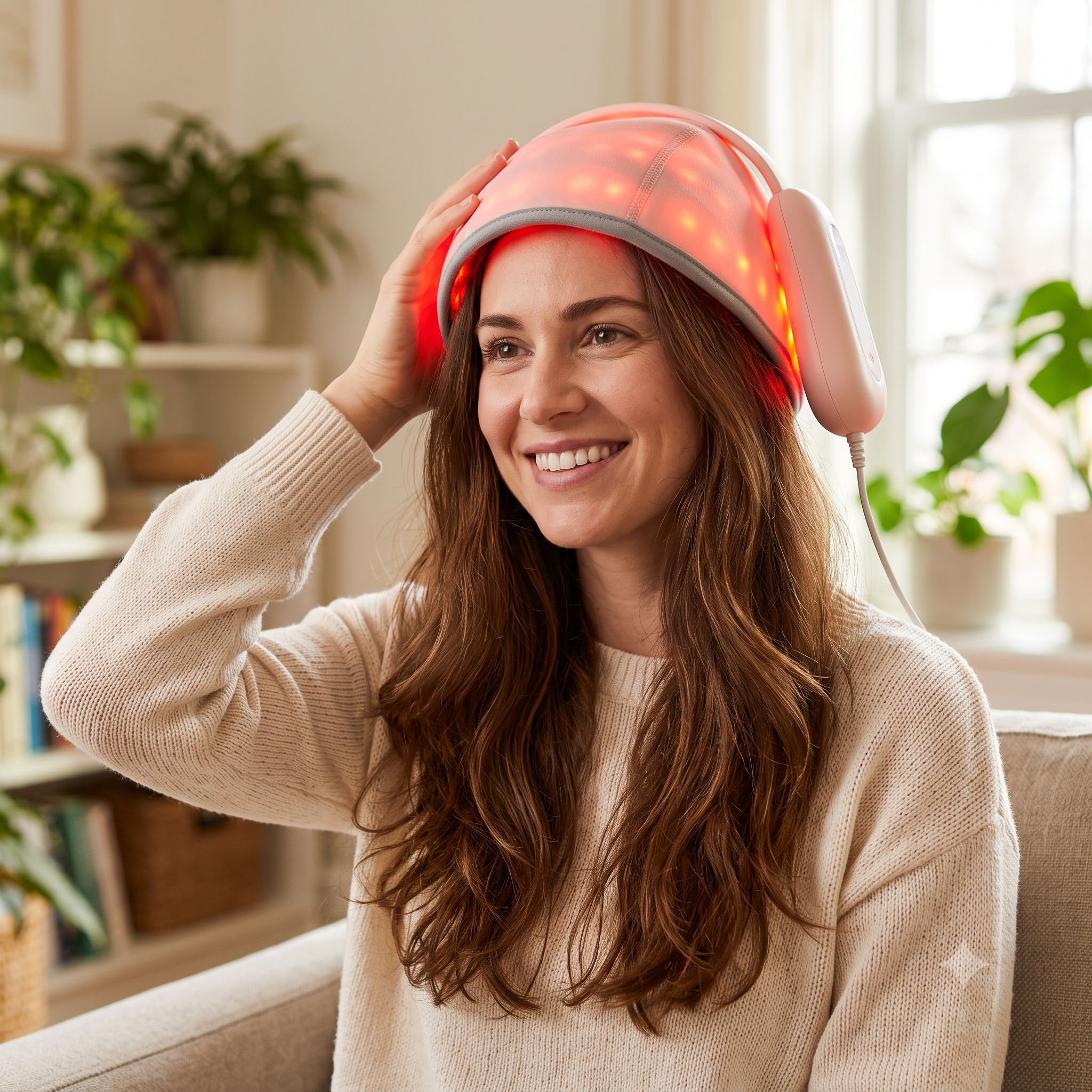
Many people with thinning hair want a simple solution they can use at home. That is why laser caps for hair growth have become popular. You may see them called a laser hat for hair, laser helmet hair growth device, red light cap, LED hair cap, laser comb, or hair growth machine.
But do they actually regrow hair?
The honest answer is: they may help some patients, but they are not a complete hair restoration plan by themselves. At PURE Medical Spa, we view at home hair loss devices as support tools, not a replacement for diagnosis.
Not sure which regenerative treatment is right for you? Schedule a Hair ReGrow Consultation.
What Are Laser Caps for Hair Growth?
Laser caps for hair growth use low-level light therapy, also called LLLT. This is a form of red light therapy hair treatment. The goal is to expose the scalp to specific light wavelengths that may help support follicle activity.
Some devices are caps. Others are combs, helmets, or bands. These are often promoted as hair regrowth devices or a home hair loss treatment.
Medical reviews describe LLLT as a non-invasive option that may help stimulate hair growth in men and women with androgenetic alopecia, also called pattern hair loss.
How Does LLLT Hair Growth Work?
LLLT hair growth is thought to work through photobiomodulation. In simple words, light energy may help cells work better.
For hair, this may support:
- Better follicle activity
- Improved scalp energy metabolism
- Longer active growth phase
- Reduced follicle miniaturization in selected patients
- Better hair thickness over time
This does not mean a laser hair device can create hair where follicles are dead or scarred. It works best when follicles are still present but weak, miniaturized, or underperforming.
Do Laser Caps Really Work for Hair Loss?
Many patients ask, “do laser caps really work for hair loss?” Research suggests that LLLT can improve hair count and density in some patients with pattern hair loss. A systematic review found that FDA-approved LLLT devices may be potentially effective for pattern hair loss, but more long-term studies are needed.
That is the key point: laser therapy hair growth may help, but results are usually gradual and modest. It is not the same as PRP, medication, regenerative treatment, or NeoGraft FUE.
A laser cap hair loss plan may be useful when:
- Hair thinning is early
- Follicles are still active
- Shedding is not severe
- The patient can use it consistently
- It is combined with a stronger treatment plan
Are Laser Caps FDA Cleared?
Some patients ask, “are laser caps FDA cleared?” Some devices are FDA cleared, but not all devices on the market have the same evidence.
Research notes that the first LLLT device was cleared by the FDA for androgenetic alopecia in men in 2007 and women in 2011. However, only a limited number of devices have strong randomized clinical study support.
This matters because “FDA cleared” does not mean every red light cap is equally effective. Device quality, wavelength, energy output, fit, and consistency all matter.
Laser Cap vs PRP
A common question is laser cap vs PRP. These are different tools.
Laser caps are home-use devices. They may help support follicle activity with light exposure.
PRP uses growth-factor-rich plasma from your own blood and is performed in-office. It may be recommended when follicles need stronger regenerative support.
At PURE Medical Spa, a Hair Loss Consultation can help decide whether your plan should include PRP, PRF, scalp treatments, home care, or advanced options.
How Often Should I Use a Laser Cap?
Patients often ask, “how often should I use a laser cap?” This depends on the device instructions. Many home-use devices are used several times per week for a set number of minutes.
The biggest issue is consistency. A hair regrowth device will not help much if it sits in a drawer. Most patients need months of regular use before judging results.
If you are not seeing improvement, the issue may not be the device. The issue may be the diagnosis.
What Is the Best Laser Cap for Hair Growth?
Patients often search, “what is the best laser cap for hair growth?” The best device is not always the most expensive one. It should be appropriate for your type of hair loss, safe to use, and backed by clinical evidence.
Before buying a laser helmet hair growth device or laser comb, ask:
- Is the device FDA cleared?
- Does it have clinical study support?
- Is it designed for pattern hair loss?
- Can I use it consistently?
- Is my hair loss still treatable with light therapy?
- Do I need a medical diagnosis first?
This is especially important if you have sudden shedding, bald patches, scalp pain, itching, or rapid thinning.
When Laser Caps May Not Be Enough
Laser caps for hair growth are not ideal for every case. They may not be enough if you have:
- Advanced baldness
- Scarring hair loss
- Active scalp inflammation
- Untreated hormone imbalance
- Nutritional deficiency
- Sudden severe shedding
- Hair loss from medication or illness
- Areas where follicles are no longer active
This is why PURE uses a diagnosis-first model through PURE Hair ReGrow.
Your plan may include:
- Scalp evaluation
- Lab discussion when needed
- PRP or PRF
- Scalp treatments
- Medical-grade home care
- NeoGraft FUE when appropriate
- Long-term hair restoration planning
Should You Buy a Home Hair Loss Device?
A home hair loss treatment may be helpful if you are the right candidate. But it should not delay medical evaluation.
If your hair is thinning quickly, if you see more scalp, or if shedding is sudden, you should not rely only on a LED hair cap or hair growth machine.
A hair thinning treatment works best when it matches the reason your hair is changing.
When Laser Therapy Makes the Most Sense
- Works Best on Living Hair Follicles
- Light therapy for hair is designed to deliver light energy that can penetrate the scalp and encourage follicles that are still alive but producing thinner hairs. It is less effective once follicles are permanently inactive.
- Supports the Scalp Environment
- Medical grade lasers may help increase blood flow around hair follicles, creating an environment that can stimulate hair growth and support healthier follicles over time.
- Not a Replacement for Every Treatment
- While therapy works for many people with male and female pattern hair loss, it does not replace topical minoxidil, hair transplants, or other treatments when they are medically recommended.
- Results Depend on the Cause
- Conditions such as female pattern hair loss or other medical conditions require different treatment plans. A single laser treatment is rarely the answer for every type of hair loss.
- Combination Therapy Often Performs Better
- Studies suggest that combining therapy for hair loss with other evidence-based treatments may improve hair growth more than relying on one treatment alone, helping hairs grow stronger and healthier.
- Professional Guidance Matters
- Before investing in any device, an experienced hair specialist or board certified dermatologist can determine whether clinically proven laser therapy is likely to benefit your specific hair loss pattern and whether additional treatments will provide better results.
Book a Hair Evaluation at PURE Medical Spa
If you are considering laser caps for hair growth, start with a proper evaluation first.
At PURE Medical Spa, our Physician Hair Restoration approach helps patients understand whether home devices, PRP, scalp treatments, or advanced Hair Restoration Chicago options may be right.
Call/Text: 312.312.7873
Or book your free complimentary telehealth hair consultation online.
Learn more here: Hair Restoration Chicago
FAQs
Do laser caps really work for hair loss?
They may help early pattern hair loss, but results are usually gradual and best with proper diagnosis.
Are laser caps FDA cleared?
Some laser caps are FDA cleared, but not every device has the same evidence or quality.
How often should I use a laser cap?
Most devices require use several times per week, but follow the device instructions.
What is the best laser cap for hair growth?
The best option is FDA cleared, clinically supported, and appropriate for your diagnosis.
Does red light grow hair?
Red light may support weak follicles, but it cannot revive areas where follicles are permanently inactive.